30
Years
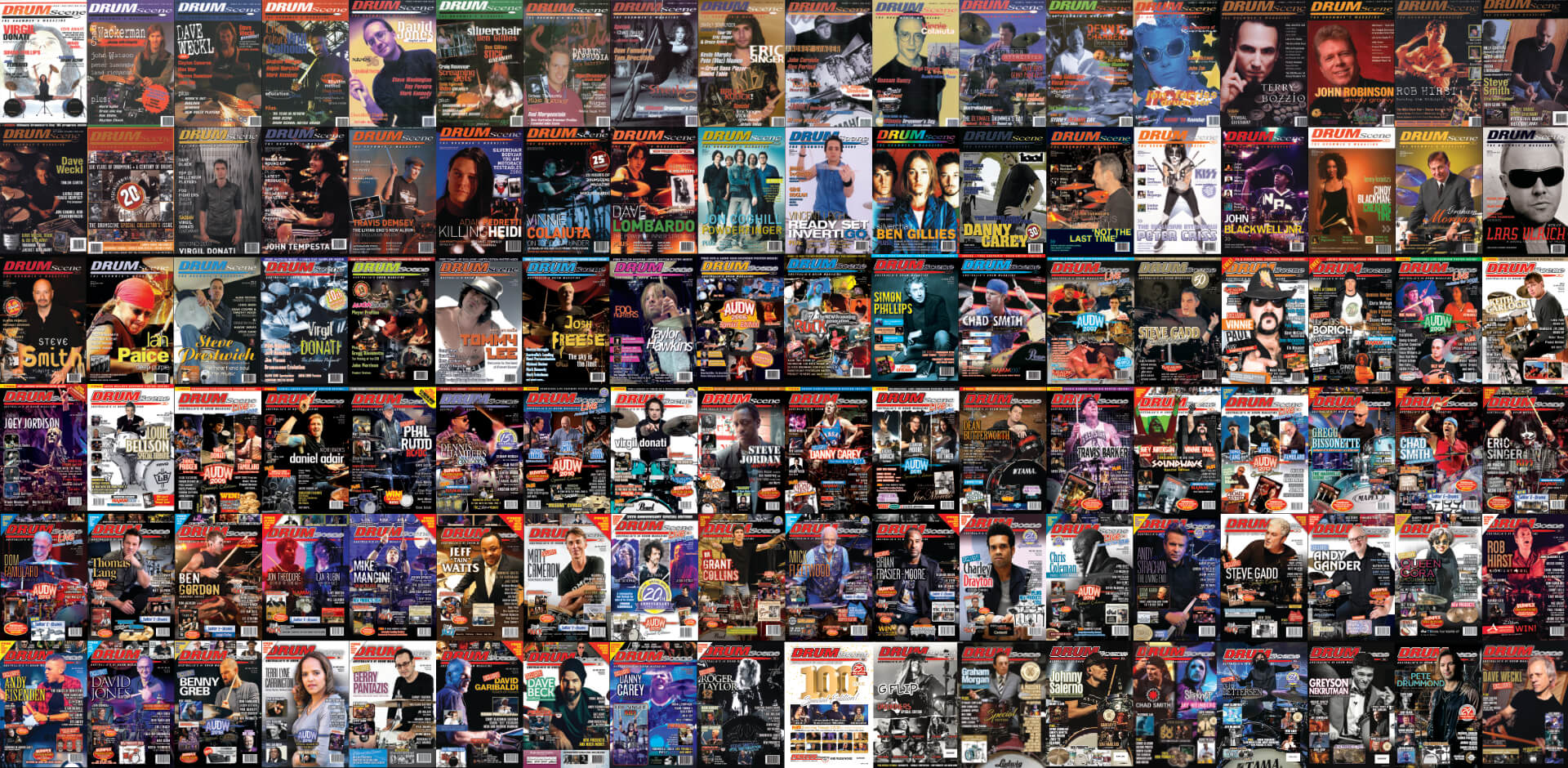
1995 – 2025 · 108 Issues · One Vision
The Man Who Couldn't Get A Publisher
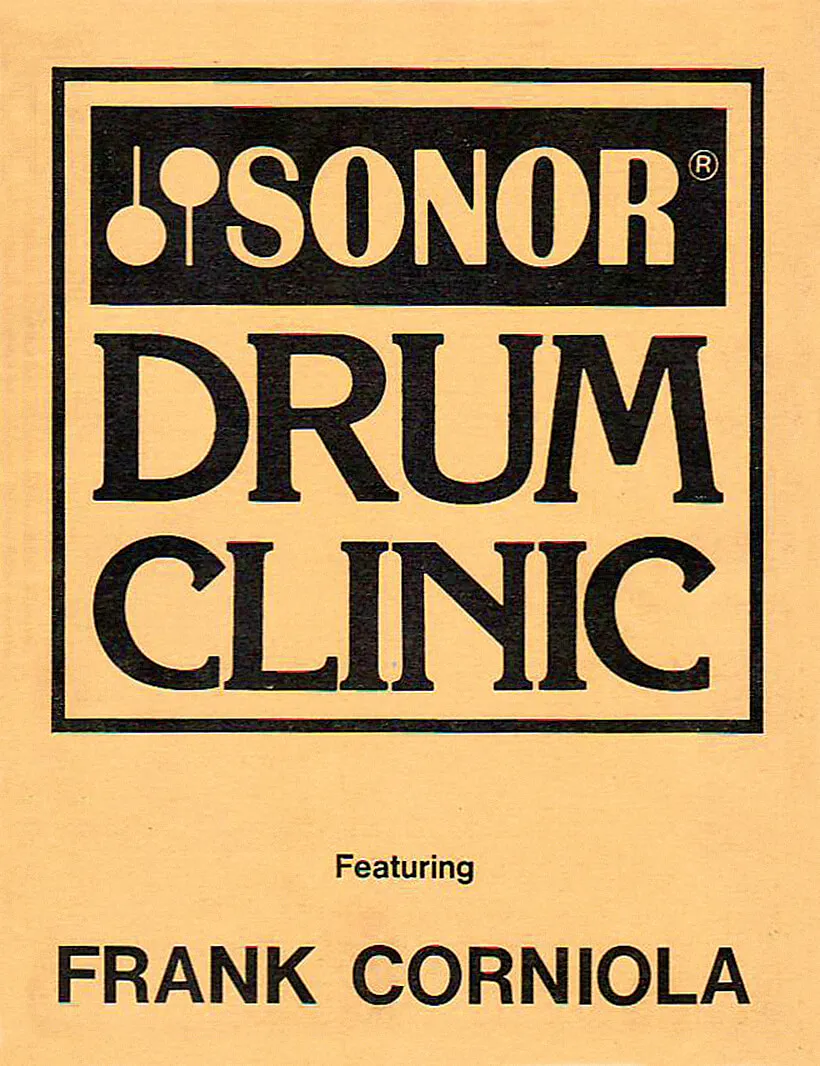
Before there was Drum Scene, there was a young drummer from Melbourne with an education obsession and a problem. Frank Cornola had spent the late 1970s on the road with the John St. Peters band, sponsored by Zildjian Cymbals and Sonor Drums, doing clinics around Australia with bassist Steve Morgan — who would later tour the world with Icehouse.
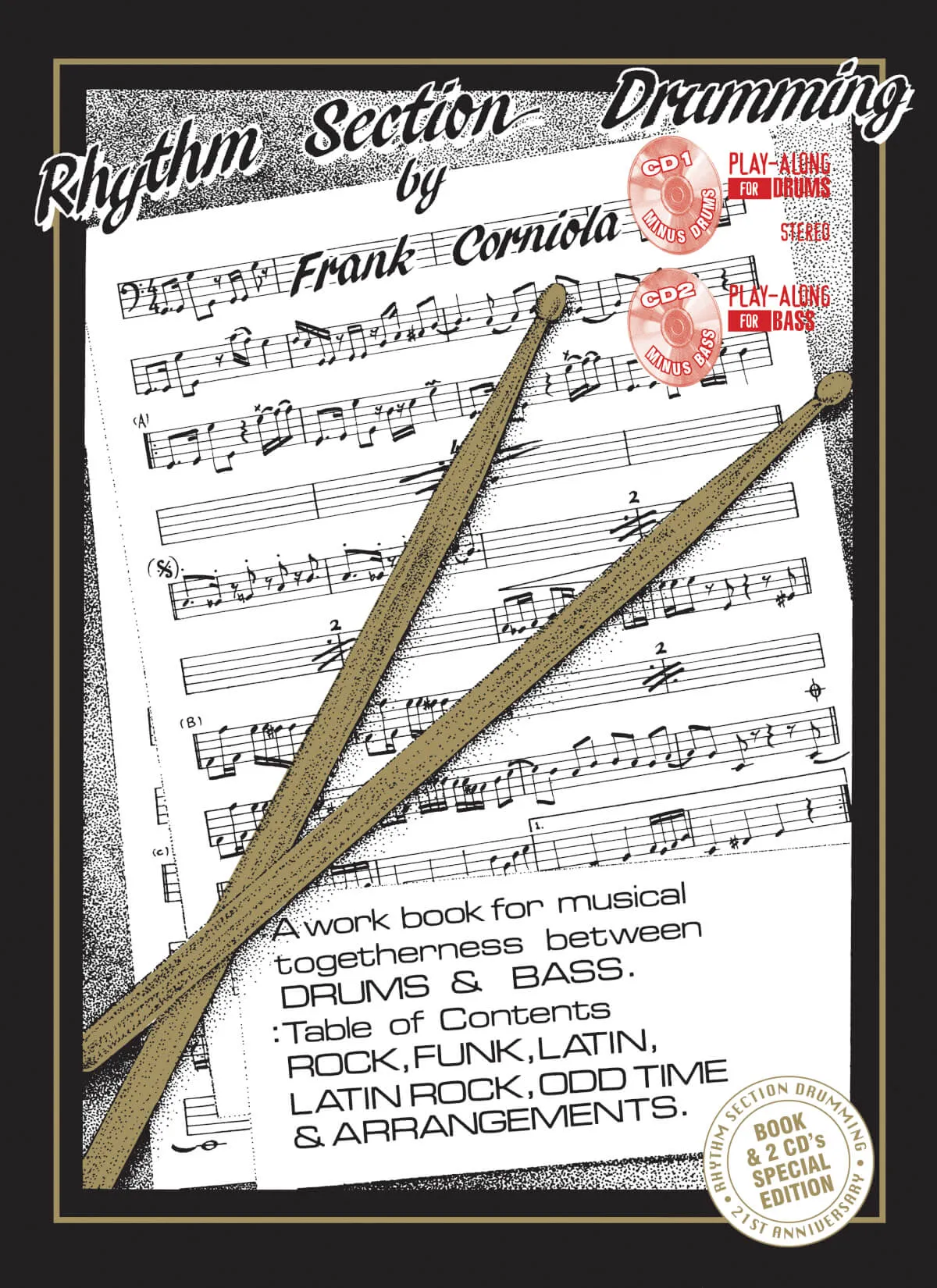
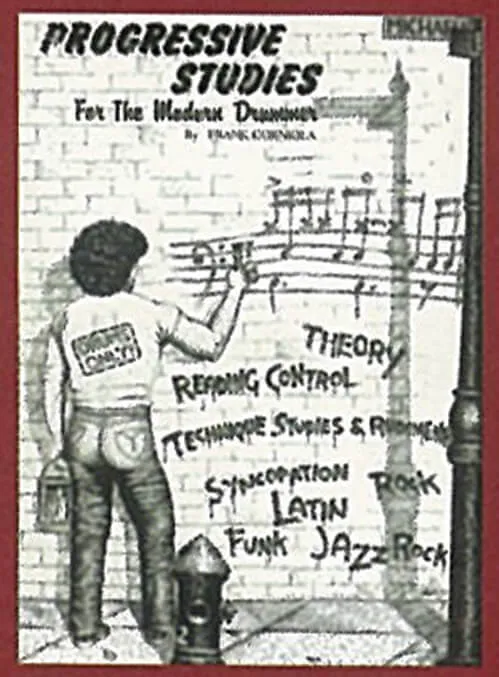
There was just one obstacle: no Australian publisher would touch a drumming book. Everything came out of America. Frank's response was characteristically direct — if no one would publish it, he'd do it himself. He founded Music Publications and in 1985 released Rhythm Section Drumming: one-bar rhythms, two-bar summaries, ten original play-along tracks. Revolutionary at a time when play-along material barely existed. Forty years later, it's still in print.
That decision — to build the thing yourself rather than wait for permission — would define everything that followed.
In The Groove
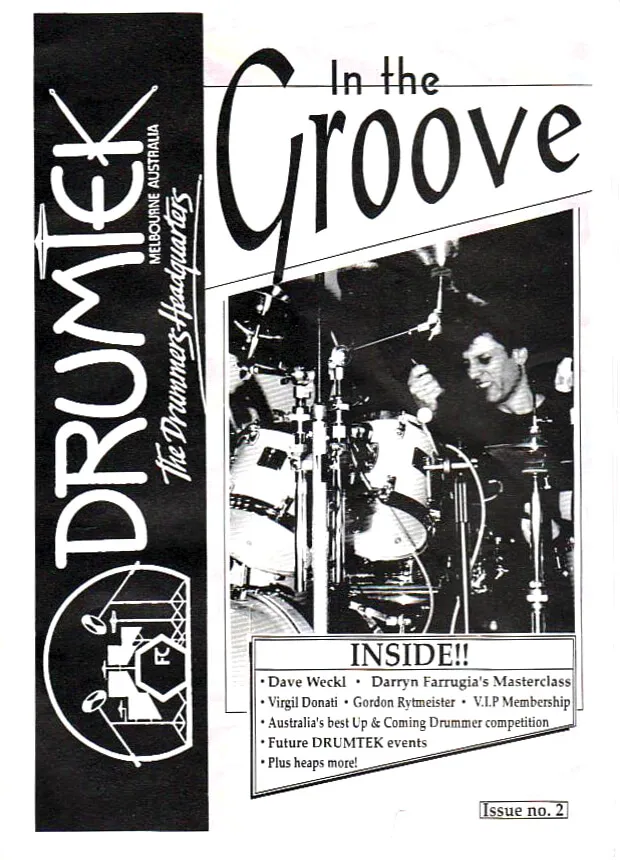
When Drumtek School of Music opened in 1992, Frank already had a publishing instinct. Almost immediately he launched an in-house newsletter called In the Groove — 16 pages, promoting events, celebrating local players, building a small community around the shop and school.
By 1994 the question had shifted from whether to do a national magazine to how. The school had grown to eleven teachers in its first year — Virgil Donati, Darren Farrugia, Alex Pertout, John Corniola, Graham Morgan, David Jones among them. The infrastructure was there. All it needed was a name. Drum Scene came simply: it described exactly what he wanted to cover. He checked — it wasn't registered. He grabbed it.
The Split
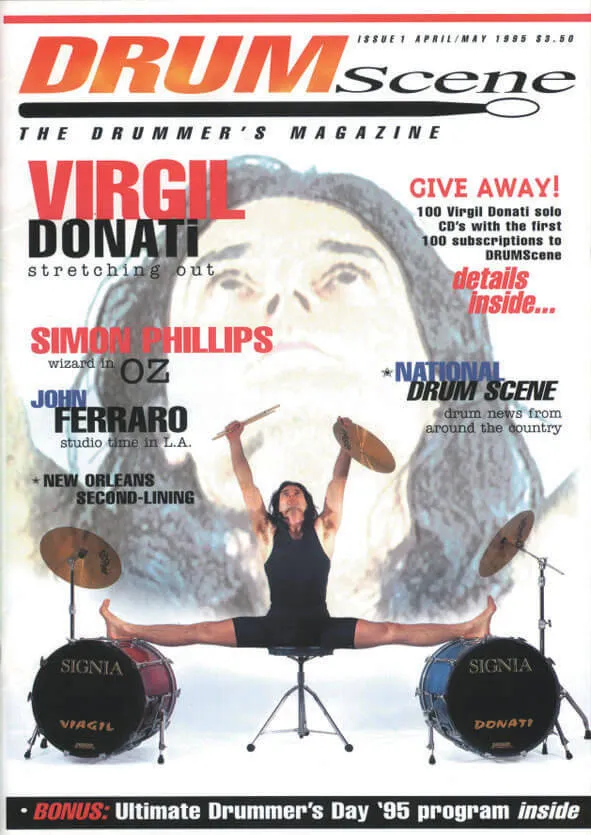
For the first cover, Frank needed impact — something that announced unmistakably that this was a serious publication, not a local newsletter. The choice was Virgil Donati, already a phenomenon in Australian drumming circles and making waves internationally.
The shoot needed a concept to match the interview title, Stretching Out. Virgil — a dedicated fitness fanatic — had the idea: he'd do the splits. Full, floor-level splits, in full drumming attire, in a hired studio. Photographer Les Walkin captured it.
For years, people assumed it was Photoshop. It wasn't. There was no Photoshop in 1995. Virgil simply did that.
Frank commissioned Virgil to record what was meant to be a short sound supplement for subscribers. It grew into a full solo album — Stretch — tied directly to the magazine's identity and sold through CD stores nationwide.
I wanted someone who would make an impact. The first cover has to declare what the magazine is.
— Frank Cornola
The Gamble
The magazine launched April 1, 1995. Gordon & Gotch placed it across some 2,000 newsagents nationally, eventually extending to New Zealand. By any external measure, it looked like a success from day one.
Internally, it was a different story. The magazine didn't make money for five years. Frank's accountant would deliver the annual news. Frank would wave it away: "I don't care. This is not what it's about." It was a passion project, subsidised by belief.
What kept it going wasn't revenue. It was the phone calls. Frank would ring drummers personally to tell them they were being featured. More than once, the person on the other end couldn't speak. That was the currency that mattered.
The Magazine That Made A Family
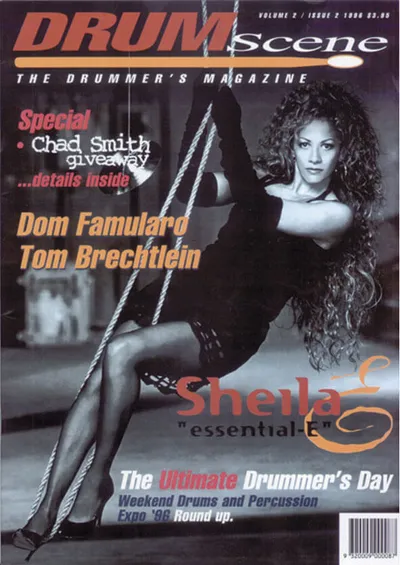
Issue 2 featured Sheila E on the cover — the first female cover — and doubled as the program for the Ultimate Drummers Weekend, which Frank had just expanded into a full two-day festival.
One of that year's performers was Dom Famularo, a dear friend of Frank's since 1993. That cover carried a name that Rosanna, living in Sydney, happened to notice in a newsagent window: Famularo. Her grandmother's maiden name. She picked up the magazine wondering if there was a connection. There was — distant relatives tracing back to the same islands off the coast of Sicily.
Dom made the introduction. Rosanna came to a Melbourne festival around the year 2000. She and Frank met. They married.
The magazine introduced Frank to his wife.
The Clinic In The Loungeroom
In 1989 — six years before Drum Scene existed — Frank was living in Warrandyte when a call came through his contact at Zildjian Australia. Dave Weckl, the drummer redefining what was possible with Chick Corea's Elektric Band, was in the country.
What followed was an informal masterclass in Frank's home studio. Forty people crammed in. Darren Farrigia was there. Jerry Pantazis was there. Young drummers sitting close enough to watch Weckl's hands in real time — in an era before YouTube, before most of them had ever seen footage of him play. They had lunch first.
Frank and Dave have been friends ever since. When the final issue of Drum Scene needed a cover, there was only one choice. The man who was there before the magazine existed closed it out on the front of issue 108.
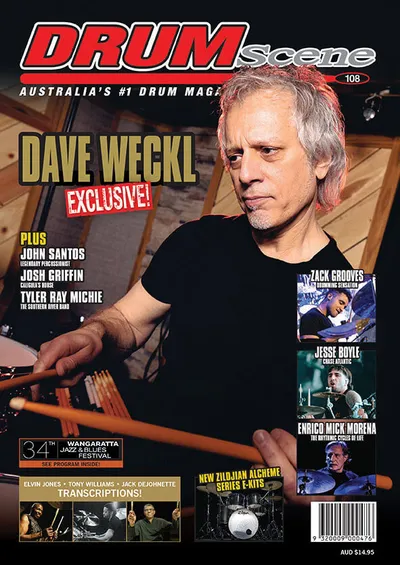
I couldn't think of anyone better. He's like an honorary Australian.
— Frank Cornola, on Dave Weckl
worth the wait.Steve Gadd · One clinic · Twenty years of asking.
Frank met Steve Gadd in New York in the early 1980s. From the moment he launched the Drummers Weekend, he approached Gadd's management every year. Every year, graciously, the answer came back: touring with Paul Simon, committed to a session, unavailable. For twenty years.
Then Gadd's management called Frank. The Steve Gadd Band was finishing a Japan tour and open to extending to Australia. Frank built a concert around it — a sold-out show at the Melbourne Recital Centre. Then he noticed a travel day in the schedule. A day off. He asked if Gadd would do a clinic at Drumtek. He said yes. It remains the only drum clinic Steve Gadd has ever given in Australia. When Frank announced him, the room gave a standing ovation that wouldn't stop.
The Archive
About twenty years ago, the National Library of Australia in Canberra contacted Frank. They wanted to archive Drum Scene — every issue, permanently, as part of the national record. Frank agreed and has sent every issue since.
Recently Frank and Rosanna visited Canberra. They walked in like any member of the public, asked to see some issues of Drum Scene, and watched as a librarian looked it up, disappeared, and returned with copies from the file. Preserved. Permanent. Accessible to anyone, forever.
The interviews in those pages don't just cover 1995 to 2025. When Graham Morgan sits for a 20-page feature, he's talking about the 1950s. When Gil Matthews reflects on his career, it's the golden era of Australian television. Drum Scene became, almost by accident, the most comprehensive document of Australian drumming culture ever assembled.
In 20, 50, or 100 years time, if someone wants to do a PhD on Australian drumming, they've got all the information there.
— Frank Cornola
Full Circle
April 1995 → 2025 · Issue 1 → Issue 108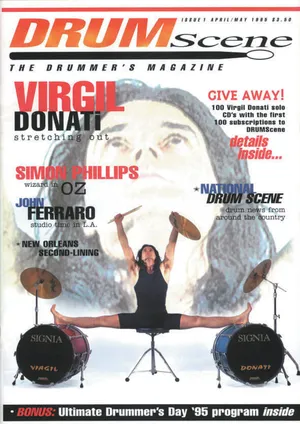 No. 1 — Virgil Donati — April 1995
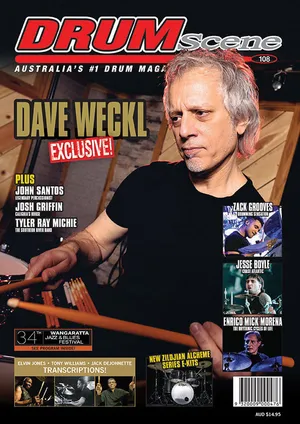 No. 108 — Dave Weckl — 2025
Between those two images: 30 years, 108 issues, 2,000 newsagents, a national archive, and a community that didn't exist before Frank decided to build one. Drumtek still runs. The back issues are still available. The National Library holds the record. The print is done. The story isn't.
Browse all 108 issues — available to explore in the archive.